Who it's forResearch teams
Research funding, and proposals that follow each funder's rules.
For university labs and small research companies. FundFellows finds NIH, NSF, and SBIR funding you can apply for, shows funded projects like yours, and drafts the proposal in the standard sections with each funder's rule on AI on the checklist.
The demo includes a fictional university research lab in Toledo, clearly labeled, and replays recorded runs. The Grants.gov notices and the NSF and NIH funded projects in it are real. It costs nothing and needs no account.
The proposal gets written between teaching, the lab, and everything else.
A principal investigator writes proposals between classes, students, and the research itself. Finding the right program means reading notices across several agencies and working out which program funds this kind of work, and who manages it.
Every proposal repeats the same pieces: biosketches, facilities, a data management plan. And each funder now has its own rule about AI in applications, and the rules do not agree.
What it does, step by step.
A profile of the team
It reads your lab page for investigators, publications, prior awards, facilities, and capabilities. Your team checks the profile before anything uses it.
Notices you can apply for
Funding notices from the NIH Guide, NSF, SBIR.gov, Grants.gov, and the Federal Register, each with a fit score, plain reasons, and a link to the official notice.
Who funds work like yours
Funded projects like yours from NSF and NIH award data. They show which programs fund this work, how much they awarded, and which program officers manage it.
A draft in the standard sections
Project summary, specific aims or objectives, research plan, broader impacts, biosketches, budget justification, data management and sharing plan, and facilities. Biosketches and facilities are built from your records, and every claim cites one.
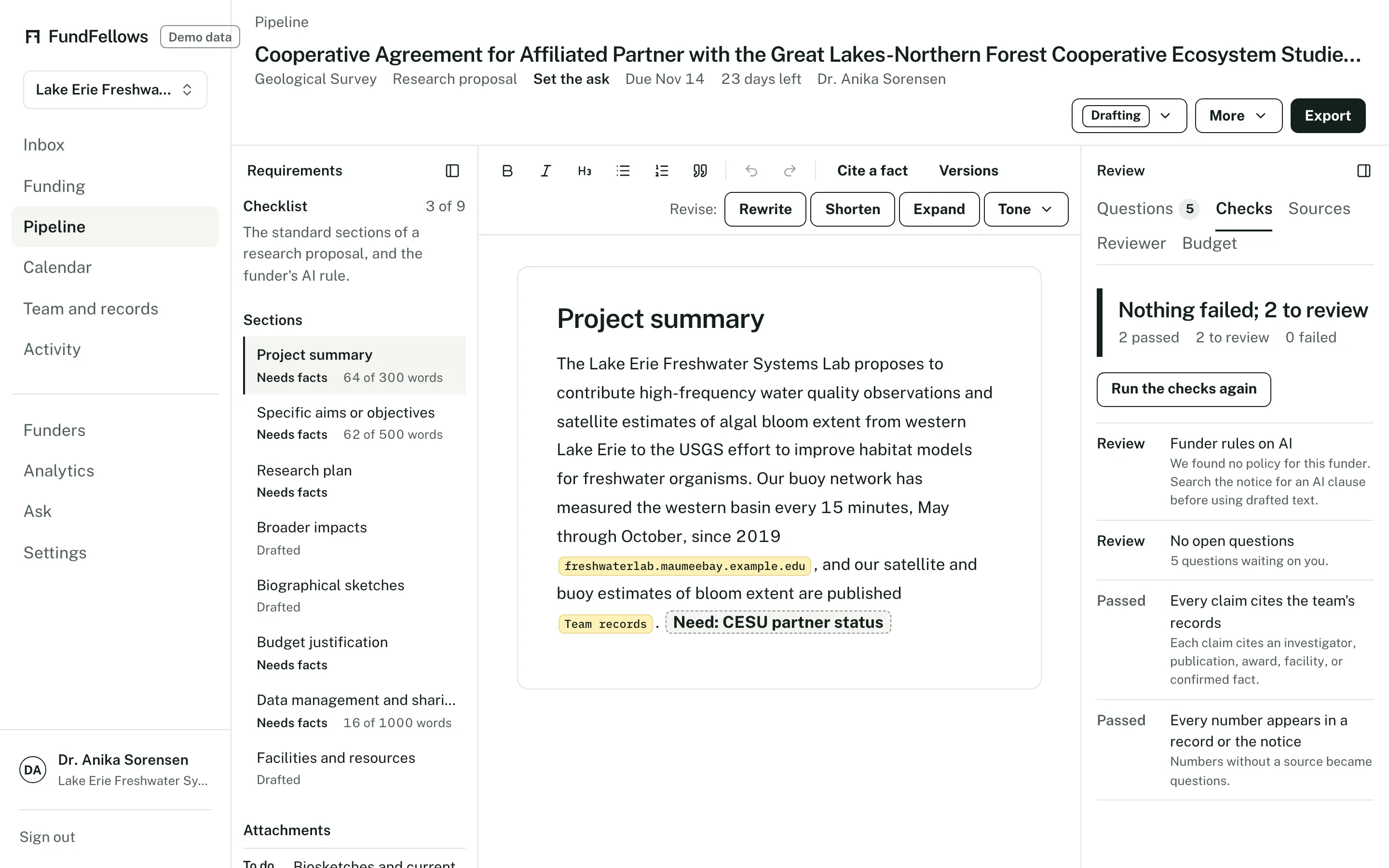
A research proposal, on demo data. The funder's AI rule is on the checklist. Each funder's rule on AI, with its source
The rule sits on the checklist with a link to where it is stated. NIH does not consider applications substantially developed by AI to be original, and caps each PI at six applications a year. NSF encourages disclosure of AI use. NASA SMD wants AI use cited. At least one current DOE Office of Science notice requires disclosure. The Department of Education allows AI with a certification.
What it will never do
- Submit a proposal. You submit it, through your institution or your company.
- Invent a publication, a prior award, or a result. A missing detail becomes a question.
- Contact a program officer or a funder for you.
- Decide for you whether your use of AI is allowed. It shows the rule and its source, and you decide.
What it needs from you
- Your lab page
- The address of the page that lists your people, publications, and facilities.
- A check of the profile
- Investigators, publications, prior awards, facilities, and capabilities, confirmed by someone on the team.
- The science
- The aims and the plan are yours. Answer its questions and edit every section.
- A decision on AI
- Read each funder's rule on the checklist, and disclose or certify the way the funder asks.
- Submission
- You submit, through your institution or your company.
Good to know
- NASA's own solicitation site has no feed. NASA notices posted to Grants.gov still appear.
- The profile is read from your lab page, and your team has to check it.
- Funders change their rules on AI. Read the current notice before you submit.
Who else it is for
- What it does for architecture and construction firmsFederal, state, and city solicitations in one search, a compliance matrix with the page behind every requirement, go/no-go with reasons, and proposals and SF 330s built from your own records.
- What it does for nonprofitsFederal grants and private foundations in every state, drafts with a source on every claim, and deadlines planned backward.
- What it does for studentsYour résumé becomes a profile, scholarships and fellowships are matched to it, and each essay is drafted from your own experiences.
Try it on a sample research lab first.
See the notices it finds, the funded work like the lab's, and a draft with the funder's AI rule on the checklist.
Free during early access, with no card.
The demo includes a fictional university research lab in Toledo, clearly labeled, and replays recorded runs. The Grants.gov notices and the NSF and NIH funded projects in it are real. It costs nothing and needs no account.