Find every grant and public bid you qualify for. Draft each one from your own records.
FundFellows reads Grants.gov, SAM.gov, state and city bid portals, NIH, NSF, and the filings of private foundations every day. It drafts each application from your documents with a source for every claim, and plans every deadline. A person approves everything.
Free during early access. No card.
Open in the database
16,790
opportunities open or announced
- Contracts and bids
- 12,846
- Federal and other grants
- 2,399
- Research funding
- 1,406
- Scholarships and fellowships
- 139
- Private foundations on file
- 81,649
From 24 official sources, measured October 22, 2026. See every source
For architecture, engineering, and construction firms
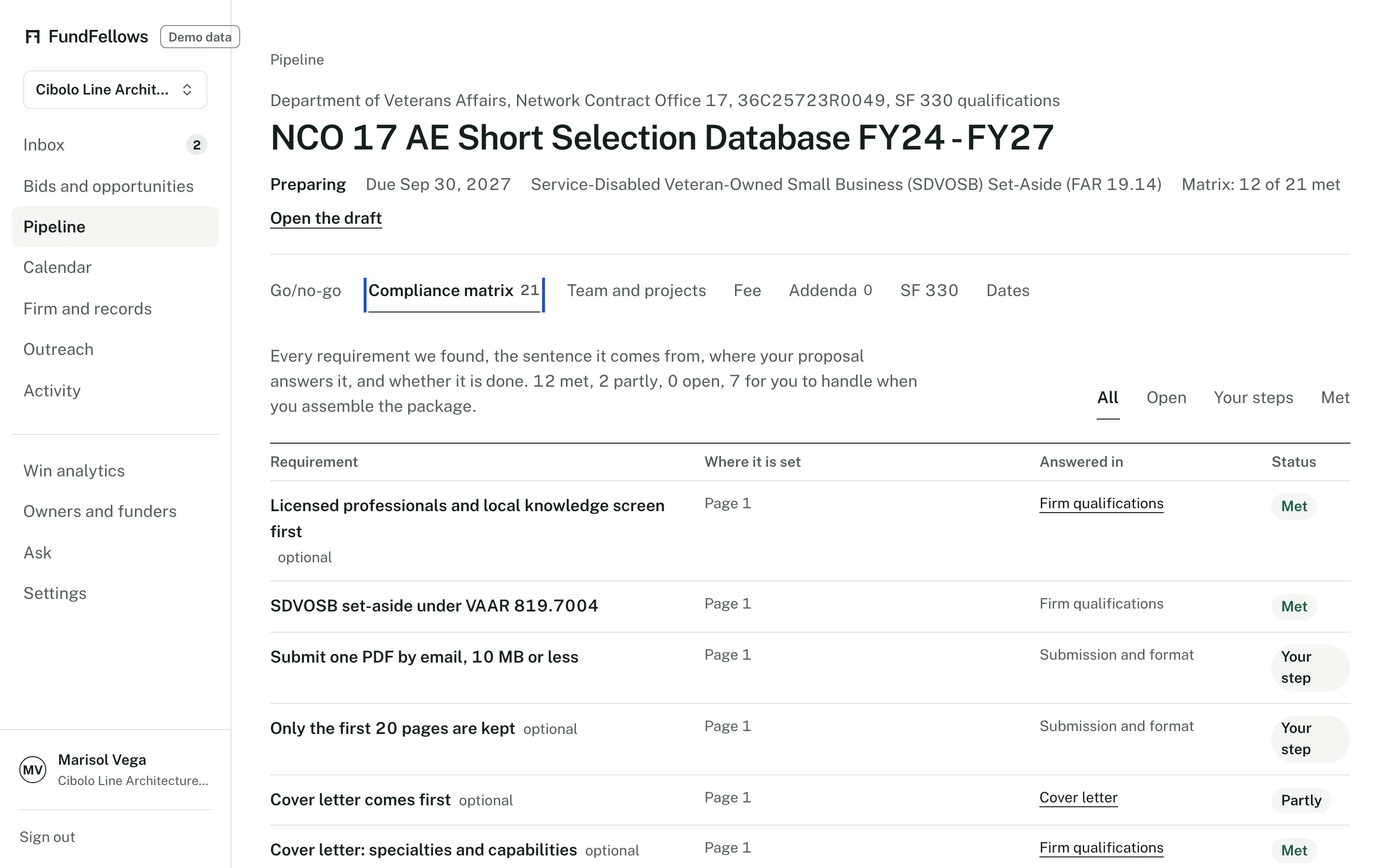
Read the solicitation once. Get the compliance matrix, the go/no-go, and the SF 330.
Upload an RFP or pick one from the database. Every requirement becomes a row with the sentence and page it came from. The go/no-go weighs your capacity, bonding, and past work, with reasons. Sections are built from your projects and people, and the SF 330 exports to Word.
- Open federal construction and A/E solicitations
- 948
- Open state and city construction bids
- 1,418
A colleague who has every record in reach.
01
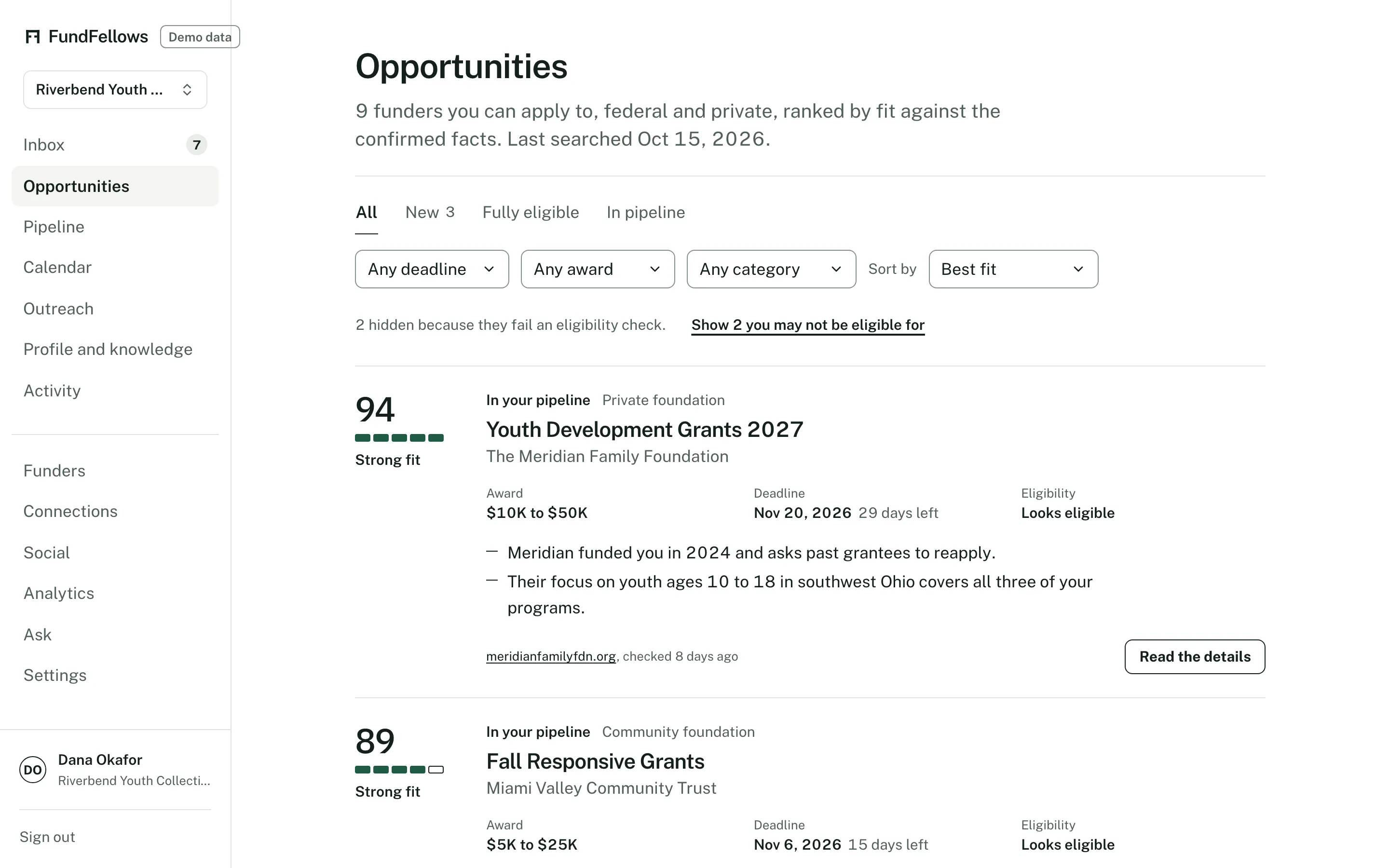
It finds what you qualify for
Tell it who you are once: your website, your documents, your work categories. It reads the database every morning and shows what fits, with the reason in your words and the line of the notice that supports it. Anything you could not apply for is set aside, with why.
02
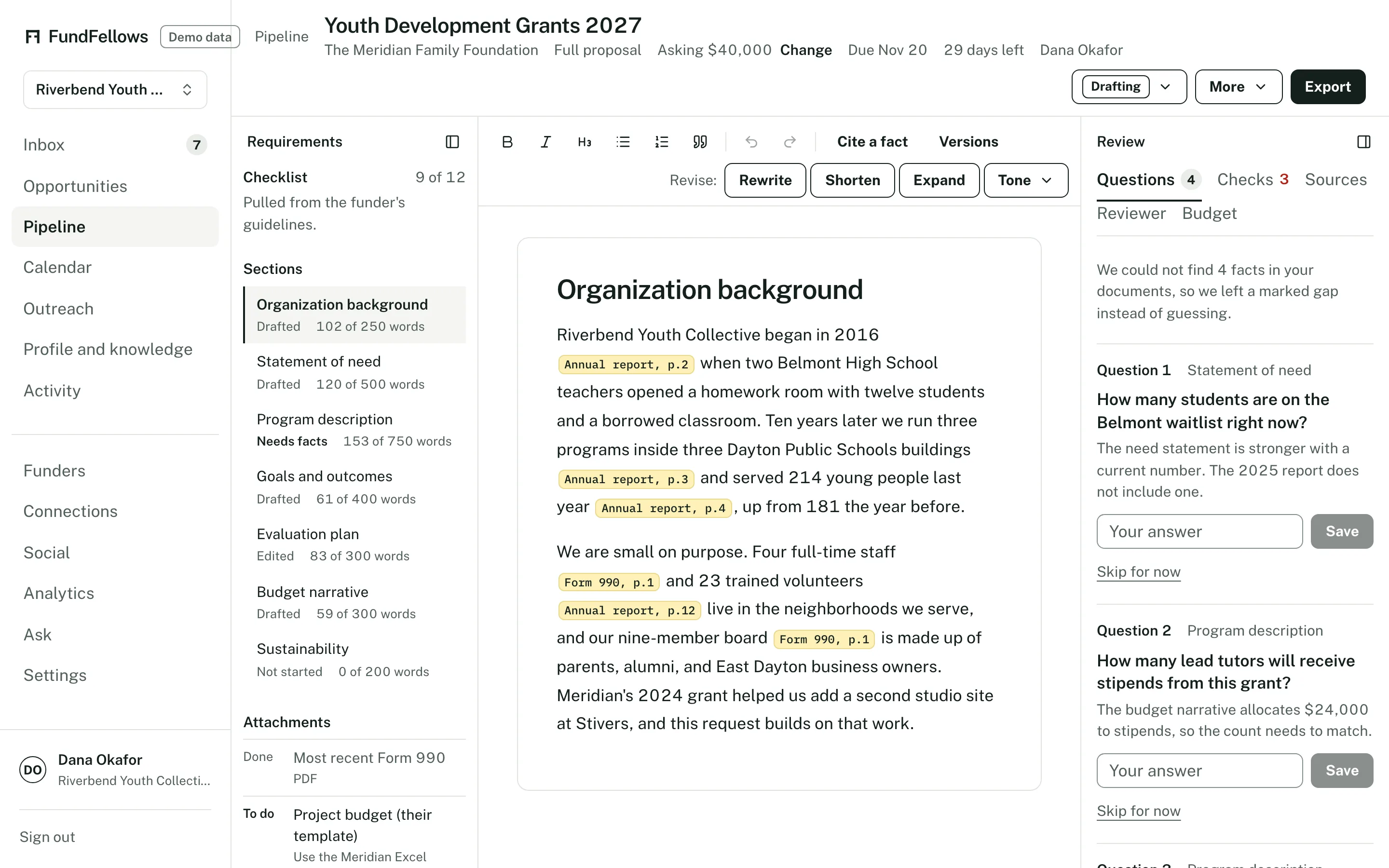
It drafts from your own records
Letters, full proposals, bid responses, research proposals, and essays, written from your documents and records. Every claim links to the sentence it came from. When a fact is missing, the draft asks you instead of guessing.
03
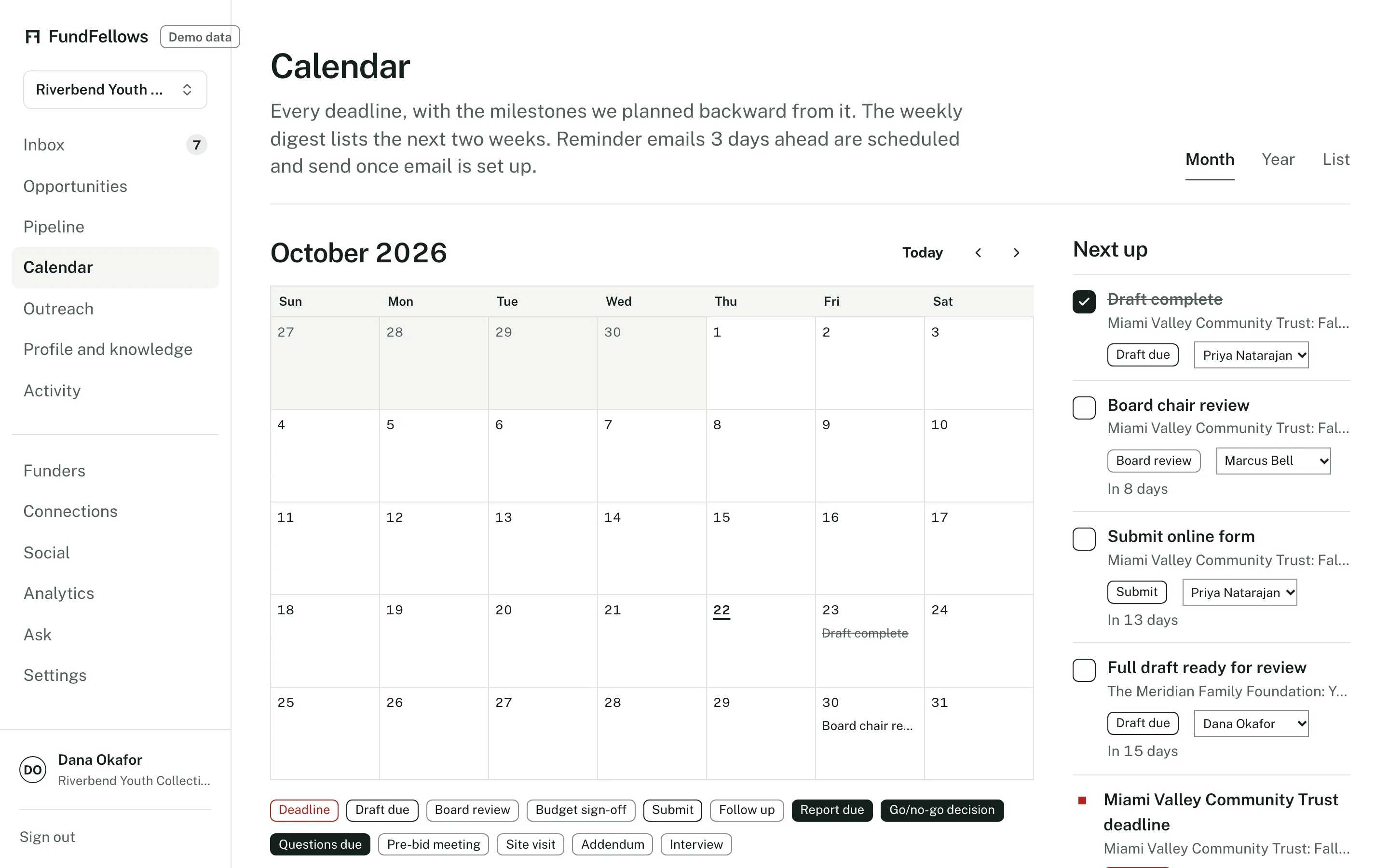
You decide, and every date is planned
Each deadline gets a plan worked back from the due date: go or no-go, questions due, drafts, review, signatures. Everything waits in one Inbox for a person to approve. Nothing is sent or submitted without you.
Every line shows where it came from.
A requirement in the matrix quotes the solicitation. A claim in a draft links to your document. When the source is not there, the draft asks you a question instead of making something up.
“Whatever documents provided, from cover letter, SF330 and SAM screen shot is to be part of the entire submission and therefore, counts towards the limit to 20 pages.”
In the compliance matrix
Whole submission, cover letter through SAM screenshot, within 20 pages.
One engine for four kinds of applicant.
Architecture, engineering, and construction firms
Finds
Federal solicitations on SAM.gov and open bids from state and city portals, filtered by your NAICS codes, region, and set-asides.
Drafts
The compliance matrix, a go/no-go with reasons, the SF 330, and a proposal built from your projects and people.
Nonprofits
Finds
Federal grants, and private foundations in every state from their IRS filings, including whether they accept applications.
Drafts
Letters of inquiry and full proposals from your annual report, your 990, and your website.
Research teams
Finds
NIH and NSF notices, SBIR and STTR solicitations, and the programs that funded work like yours.
Drafts
Proposal sections, biosketches, and facilities from your records, with each funder's rules on AI on the checklist.
Students and individuals
Finds
National scholarships and fellowships, each checked on the sponsor's own page, and foundations that give to individuals.
Drafts
Essays in your own voice, from your own experiences. It asks instead of inventing.
What it will never do.
- Send, submit, post, or sign anything for you.
- Name a funder, a deadline, or an amount that is not in a public source we can link to.
- Put a number in a draft that is not in your records.
- Show who won a contract. Past awards are kept only as totals.
- Train AI models on your documents.
Free while we learn.
No paid plan, no card, and no trial that runs out. We want to find out whether this is truly useful before anyone pays for it. Each workspace has a monthly allowance of AI work, and searching the database never counts against it.
Questions people ask first.
Where do the opportunities come from?
Only from official public sources, each linked: Grants.gov, SAM.gov contract opportunities and assistance listings, the Federal Register, NIH, NSF, SBIR.gov, bid portals published as open data by states and cities (New York City, Los Angeles, San Francisco, Texas DOT, Delaware, Montgomery County, Illinois), IRS filings for private foundations in every state, international public tenders, and a list of national scholarships checked by hand on each sponsor's page. The Data page lists every source, its license, and how often we refresh it.
Does it make things up?
It is built not to. FundFellows never names a funder, deadline, or amount from memory: each one comes from a source record with a link and the date we last checked it. Each claim in a draft links to the sentence it came from in your documents. When a fact is missing, the draft asks you instead. A model can still misread a source, so check the citations before you submit.
Does it submit or send anything for us?
No. FundFellows drafts and you decide. Proposals and the SF 330 export as Word files for you to submit through the funder's or agency's portal. Emails open in your own mail app, or send from your connected account only when you press Send. Every step the assistant takes is written to a log you can read.
We are a construction or design firm. Will it find our bids?
It finds federal solicitations on SAM.gov by your NAICS codes, set-asides, and place of performance, and open bids from the state and city portals that publish them as open data. Many state portals do not allow automated reading, so coverage is uneven by state and growing. Any RFP you find elsewhere can be uploaded or linked, and it gets the same compliance matrix, go/no-go, and SF 330.
Who sees our data, and does anyone train on it?
The people you invite. Data is stored in a Postgres database in the United States, with database rules that keep one workspace from reading another. Drafting uses Google's Gemini API on its paid tier, where Google does not use prompts or outputs to train its models. We do not train models on your documents.
Will funders know AI helped, and do we have to disclose it?
It depends on the funder. NIH and some foundations ask about AI use; others say nothing. We show a funder's AI rule on the checklist when we have it, with its source. You edit and approve the draft, so you are the author.
What does it cost?
Nothing during early access. There is no paid plan and no card. Each workspace has a monthly allowance of AI work, which covers what the model costs us. Searching the opportunity database never counts against it.
What if the draft is wrong or sounds nothing like us?
Edit it, or say what is off and ask for another pass. Drafts are built from your own documents, so more material gets you closer. A wrong fact is a bug: send it with the citation and we will fix the reading.